chelombus
Chelombus.
A search map for 9.6 billion possible drug-like molecules.
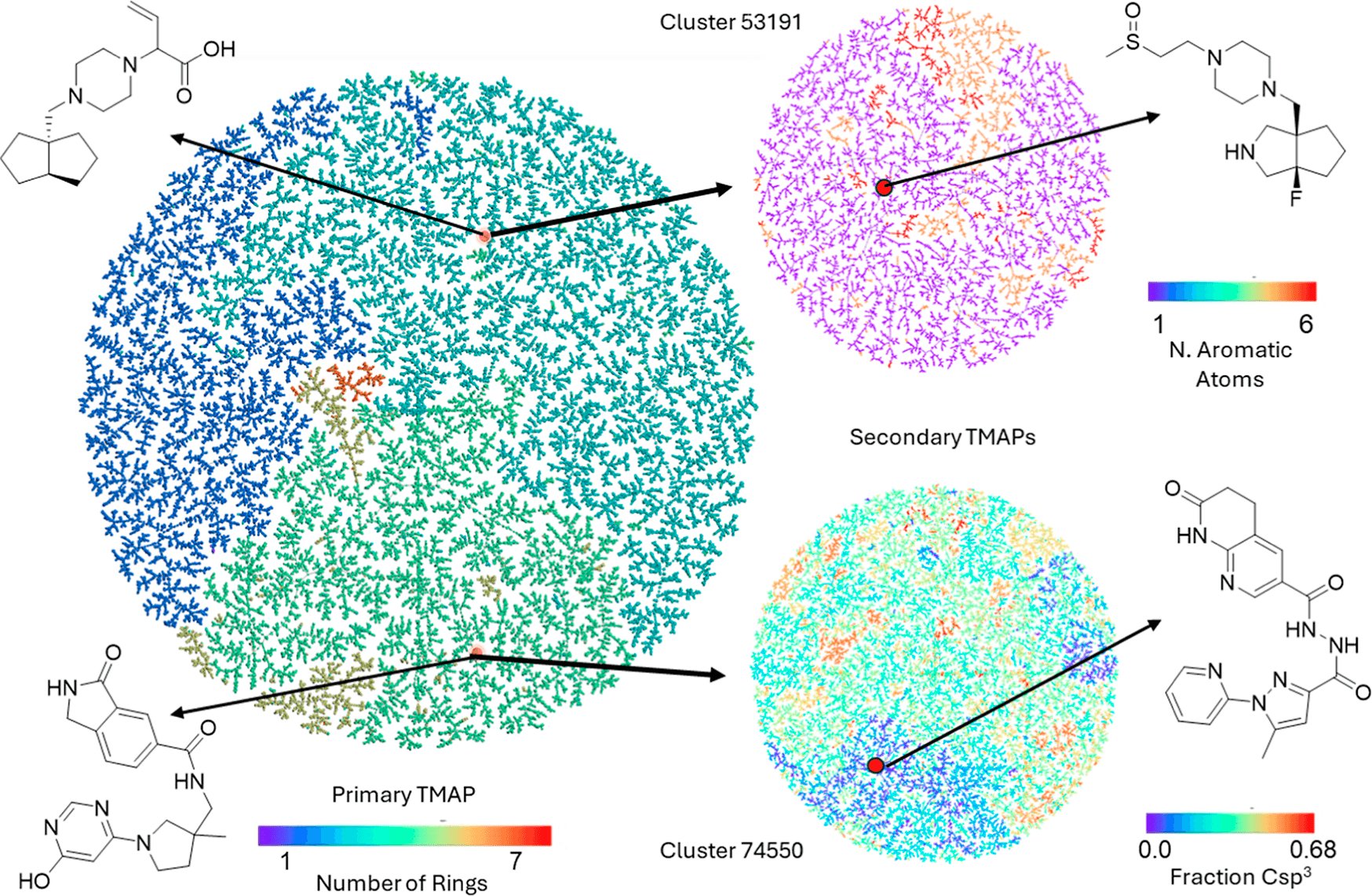
Drug discovery often starts from virtual libraries far too large to go through one molecule at a time. Chelombus turns the 9.6 billion molecules of Enamine REAL into a map. Similar molecules sit together in clusters, and you can zoom from the top-level map down to single structures.
Published · J. Chem. Inf. Model. 2026
The map, top level
Nine point six billion molecules; ninety-two thousand landmarks
i.The problem
A make-on-demand catalog like Enamine REAL lists billions of compounds, and a chemist still has to decide which of them to look at: which molecules resemble a hit, which parts of the catalog are diverse, where to go next.
Chelombus does the first pass over the catalog. It groups the molecules by similarity, draws a top-level map of the cluster representatives, and lets you open any cluster to see the molecules inside it.
ii.How it works
Each molecule becomes a 42-dimensional MQN fingerprint, which is 42 counts of things like atoms, bonds and rings. Product quantization compresses each fingerprint to a 6-byte code, and PQk-means on the GPU assigns every code to one of 100,000 clusters.
The catalog is never held in memory all at once. It streams through the pipeline in batches, and custom Triton/CUDA kernels do the expensive step of finding each molecule's nearest cluster. The full Enamine REAL run takes about 4.5 hours on a single RTX 4070 Ti; the reference C++ pipeline took about 14 days.
iii.Who can use it
Since it runs on one desktop GPU, a lab can cluster a billion-molecule catalog without a compute cluster. The chemist reading the map doesn't need to know anything about the compression: points that sit close together are related chemistry, and sparse regions suggest diversity.
The paper, with me as first author, is published in the Journal of Chemical Information and Modeling (DOI: 10.1021/acs.jcim.6c00420).
iv.The website
The maps are online at chelombus.gdb.tools. It's a Next.js site behind Nginx, running in Docker under systemd, and it serves more than 180,000 pre-generated TMAPs straight from disk with cache headers.